





Choosing today, sailing tomorrow
Our tips for
successful blue water cruising
Preparing for a long sea voyage is not something you can improvise. From the choice of boat to essential equipment, technical preparation and safety, every detail counts. At Garcia Yachtswe support sailors in their projects with sound advice and proven expertise. Discover our recommendations to help you make the right choices and sail with peace of mind.
How to Maintain an aluminium Sailboat aluminium A Systematic Approach to Ensuring Safe Sailing
Choosing an aluminium sailboat for a blue water cruising round-the-world project is no accident. It is a well-thought-out decision that prioritizes reliability, self-sufficiency, and the ability to maintain a high level of control over the long term.
Contrary to popular belief, maintaining an aluminium sailboat aluminium complex nor burdensome. When based on a clear understanding of the mechanisms at play—particularly corrosion—and on the overall coherence of the systems on board, it becomes predictable, structured, and entirely manageable.
In this context, an aluminium sailboat is aluminium merely about durability. It is a sailing platform designed to maintain its structural integrity, performance, and overall condition for decades.
For dedicated sailors, those planning to live aboard, or those sailing in remote areas, maintenance is part of a broader approach: that of mastering the boat as a whole.
Why maintenance is a key issue in blue water cruising
aluminium particularly well-suited for offshore and long-distance sailing because of its mechanical properties.
In the event of an impact, it can deform without breaking, thereby preserving hull integrity. This capability is essential when navigating in challenging, remote, or poorly charted environments.
It allows you to handle these situations not by avoiding the risk, but by relying on a boat designed to withstand the stresses.
In addition, there is a major operational advantage:aluminium repaired in most parts of the world, which enhances the sailor’s self-sufficiency.
Like any sailboat, an aluminium sailboat aluminium thorough maintenance. However, this maintenance depends less on the frequency of the tasks and more on their effectiveness: it involves monitoring and checking key parameters—particularly corrosion—in a consistent and ongoing manner.
.png)
Understandingaluminium Corrosion: A Systems Approach
Corrosion: an electrochemical imbalance
Corrosion is a natural electrochemical process in which a metal gradually breaks down due to the effects of oxygen and moisture.
In the marine environment, saltwater acts as an electrolyte, facilitating electrical exchanges and accelerating the process.
At the microscopic level:
- an area becomes the anode and deteriorates
- the other becomes the cathode and remains shielded
This mechanism is based on the flow of electrons, which reflects an imbalance between different materials or different regions of the metal.
In other words, corrosion is not an isolated event: it is the direct result of an imbalance within a system.
Noble metals: Understanding their interactions
The concept of noble metals helps us understand these interactions.
- stainless steel → very high-grade
- copper → more noble thanaluminium
- aluminium less noble
- zinc / magnesium → sacrificial
In this context, sacrificial anodes a crucial role: they are designed to corrode in place of critical components, thereby absorbing the electrochemical imbalance.
.jpg)
aluminium a naturally protective material
aluminium one fundamental property: it protects itself.
When exposed to air, it forms an oxide layer (alumina) that acts as a stable barrier. As long as this layer remains intact, it prevents corrosion from progressing.
On an aluminium sailboat, corrosion therefore only occurs when this protective layer is compromised, usually due to:
- contact between incompatible materials
- stray electric currents
- deterioration of surface coatings
Corrosion then becomes an indicator: an indicator of a loss of system integrity.
Galvanic and electrolytic corrosion: two distinct mechanisms
Two mechanisms must be distinguished:
- galvanic corrosion, caused by potential differences between metals
- electrolytic corrosion, caused by the presence of stray currents
The latter is often the most critical. It can be sudden, difficult to detect, and highly destructive.
It is generally associated with:
- grounding faults
- wiring issues
- a poorly insulated shore power connection
As part of a proactive navigation strategy, these phenomena must be anticipated and incorporated into a comprehensive control approach.
Best practices for maintaining an aluminium sailboat
Regular inspections: maintaining consistency over time
The interview relies above all on the ability to observe in a structured manner.
- A monthly inspection helps identify any emerging issues
- A thorough annual inspection allows for the verification of:
- the hull
- the welds
- the appendices
- sensitive areas
This consistency helps maintain the system's integrity over time.
Cleaning: Preserving the Material's Balance
Cleaning should remain simple and controlled:
- rinsing with fresh water
- neutral products
- absence of harsh chemicals
The goal is to maintain the material’s equilibrium without compromising its protective properties.
Electrical system: a critical checkpoint
The electrical system is a key component of corrosion control. It should be viewed as a true control system:
- connection quality
- mass consistency
- battery status
Even a minor defect can generate stray currents capable of throwing the entire system out of balance and accelerating corrosion. This is particularly critical following any modification or technical work.
sacrificial anodes : tailored and scalable protection
sacrificial anodes play a key role in maintaining the electrochemical balance of an aluminium sailboat. Their function is to corrode intentionally in order to protect the most vulnerable structural components, particularly the hull.
Their sizing is never left to chance. It depends, in particular, on the hull surface area, the volume of metal to be protected, and the boat’s overall design. Depending on the areas involved, different alloys are used: sacrificial anodes are generally used for the hull keel, while sacrificial anodes protect electrically isolated components, such as the propeller shaft or the propeller itself.
Their maintenance must be carried out on a regular and systematic basis. hull sacrificial anodes hull generally replaced once a year, while those on the propeller often need to be replaced every six months. In all cases, it is recommended never to exceed a 50% wear threshold in order to maintain effective and consistent protection.
The performance of sacrificial anodes significantly depending on the navigation environment. In marinas, the presence of metal structures and stray currents accelerates their consumption. On the open sea, the system generally operates more stably. Conversely, in freshwater, the low conductivity significantly slows down electrochemical reactions and limits wear.
.png)
aluminium antifouling aluminium maintaining system integrity
Choosing the right antifouling paint is a particularly sensitive issue for aluminium sailboats. Copper-based antifouling paints are incompatible with this material, as they can cause severe galvanic corrosion. Using a suitable system is therefore essential to preserving hull integrity hull time.
This protection generally consists of two complementary components: a seamless epoxy barrier designed to insulatealuminium, and a copper-free antifouling paint specifically formulated for aluminium hulls.
Beyond the antifouling performance itself, the primary goal is to maintain the electrochemical integrity of the entire system.
Mistakes to Avoid
Problems encountered on an aluminium sailboat rarely aluminium from the material itself. They are most often the result of an imbalance caused by certain maintenance or design flaws.
The most common situations involve:
- the mixing of incompatible metals;
- the use of an unsuitable antifouling paint;
- inadequate monitoring of the electrical system;
- the use of harsh cleaning products;
- or the lack of regular inspections.
In most cases, a consistent and methodical approach is sufficient to ensure a high level of reliability over time.
Maintenance Checklist
Maintaining an aluminium sailboat ultimately aluminium to a few simple but essential habits.
Keeping the hull as dry as possible helps minimize persistent moisture issues. It is also essential to monitor for any electrical leakage, particularly after technical work, modifications to the hull, or a long period of inactivity.
The hull be cleaned using compatible, non-abrasive products to preserve thealuminium natural protective propertiesaluminium the integrity of the coatings.
Finally, as with any sailboat intended for blue water cruising, it is recommended that you regularly inspect the appendages, rudder, and steering systems, especially before a long voyage or challenging sailing conditions.
Why choose the expertise of Garcia Yachts enhances maintenance expertise
At Garcia Yachts, maintenance is integrated from the design stage as part of the boat’s overall system.
The goal is not to eliminate maintenance requirements, but to make their management predictable, consistent, and controllable over time, even in demanding environments.
This approach is reflected, in particular, in an optimized distribution of sacrificial anodes , systematic isolation between the various metals on board, and special attention to the electrical architecture.
The circuits are shielded, the connections are secure, and the bipolar DC circuit prevents the hull acting as a return path. This design significantly reduces the risks associated with stray currents, which are among the leading causes of electrolytic corrosion.
Garcia sailboats also feature ground fault detection systems that allow for quick monitoring of the vessel’s electrical integrity, as well as isolation transformers designed to protect the hull connected to the dock.
All of these choices are part of the same approach: to maintain a high level of technical consistency and control of the boat over time.
.jpg)
Conclusion: Sustainable expertise in the service of navigation
A aluminium sailboat offers a particularly high level of reliability over time.
By understanding the mechanisms of corrosion and applying simple yet rigorous practices, it becomes possible to sustainably preserve the structural integrity of the boat while maintaining a high level of safety and technical soundness.
In this approach, maintenance is not an additional burden. On the contrary, it becomes a tool for control, supporting ambitious, autonomous, and sustainable navigation projects.
FAQ: Maintaining an aluminium Sailboat
How can the risk of corrosion between stainless steel andaluminium be effectively minimizedaluminium
On an aluminium sailboat, understanding the interactions between materials is an integral part of the boat's design.
Stainless steel components—such as balconies, stanchions, deck fittings, or hardware—must never come into direct contact with the aluminium structure. They are always insulated using non-conductive interfaces to maintain the electrochemical integrity of the entire system.
This isolation approach prevents the formation of galvanic couples that could cause long-term instability in the hull protective system.
Why is the electrical system such a sensitive issue on an aluminium sailboat aluminium
The electrical system is one of the key areas to monitor on an aluminium sailboat, as it directly affects the boat’s electrochemical balance.
A wiring defect, an inconsistent ground connection, or stray current can cause electrolytic corrosion, which can sometimes progress rapidly and be difficult to detect at first.
When it comes to blue water cruising challenging sailing conditions, monitoring the electrical system is not merely a matter of routine maintenance: it plays a direct role in maintaining the boat’s structural integrity over time.
How can you check for the presence of stray currents on board?
The monitoring of ground faults relies on dedicated detection systems that measure potential electrical leaks between different points on board.
These checks make it possible to quickly identify an anomaly before it causes a more significant electrochemical imbalance.
They are particularly important:
- after a technical procedure;
- after a modification to the electrical system;
- or after the boat has been out of use for a long time.
In offshore operations, this type of inspection is part of essential monitoring routines.
Why use a two-wire electrical system on an aluminium sailboat aluminium
A bipolar circuit ensures that the aluminium structure aluminium used as an electrical return path. Current flows exclusively through the cables designed for this purpose, which significantly limits the risk of stray currents and reduces electrolytic corrosion. This design also helps preserve the sacrificial anodes for a longer period and maintains greater stability in the overall electrical system.
aluminium maintaining an aluminium sailboat really more complicated?
No. In practice, maintaining an aluminium sailboat aluminium more labor-intensive than maintaining any other; it simply follows a different approach. The goal is not to increase the number of maintenance tasks, but to maintain the system’s integrity over time:
- corrosion monitoring;
- monitoring of sacrificial anodes
- inspection of the electrical system;
- ensuring material compatibility.
With meticulous design and regular inspections, maintenance becomes predictable, structured, and perfectly compatible with a blue water cruising program.
Aluminum hull sailing yacht safety above all
Safety is undoubtedly the primary reason for choosing aluminum. In bluewater cruising passages are long weather can be unpredictable and sailing areas may be poorly charted with the risk of unexpected encounters or even navigating in ice. The requirement for strength becomes even more critical in such demanding programs. Aspiring circumnavigators are therefore reassured by the proven robustness of an aluminum hull.
.png)
Excellent shock absorption capacity
One of aluminum’s major advantages lies in its mechanical behaviour. More ductile than composite materials it can deform without sudden failure when subjected to significant loads. This ability to absorb impact energy is a decisive advantage against the hazards encountered at sea where more rigid materials such as GRP composites may crack or fail abruptly.
%20(1).png)
Structural safety in the face of unforeseen situations
It is precisely in unforeseen situations that aluminum provides greater safety and peace of mind. Recent cases of interactions with orcas in the North Atlantic offer a clear example repeated and forceful impacts on the rudders place sudden loads on the hull. Composite materials cannot effectively absorb such shocks and may ultimately delaminate or fail potentially leading to water ingress.
But above all, on a Garcia sailboat, the rudder tube through which the rudder stock passes through the hull welded to the hull. And the rudders themselves are made of aluminium, which is extremely resistant. The risk of damage from orcas is therefore virtually zero on a Garcia.
%20(1)%20(1).png)
Proven choices in shipbuilding
Aluminum grades are differentiated according to their composition properties and recommended uses. Identified by series they include for example:
- Aluminum alloys in the 1000 series, which are more than 99% pure, are the preferred choice for electronics and packaging.
- The 2000 series (aluminum copper alloy) is preferred by the aerospace industry.
- The 5000 series aluminum (alloys aluminum magnesium and manganese) offer high mechanical strength good weldability and excellent corrosion resistance making them particularly well suited for marine applications.<br>
At Garcia Yachts, 6005, 6060 and 6082 alloys known for their high rigidity particularly in extrusions are used for the structural elements of our aluminum monohulls frames longitudinals floors and reinforcements. These alloys are therefore found in the extruded profiles and machined components that form the yacht structure.
The 5000 series alloys, which are highly ductile—a must for forming a hull without a sheer—are used for the plating, or outer skin, of the hull. They also provide very high mechanical strength, even when welded.
%20(1).png)
Understanding the mechanical strength of aluminum
The mechanical strength of a material is commonly expressed in megapascals MPa a unit used to quantify the stress it can withstand. One MPa corresponds to the pressure of a force of 10 kilograms applied over one square centimetre. 320 MPa therefore represents for example the pressure of 320 tonnes applied over one square metre. However this strength is not defined by a single value. It is assessed through several parameters including the yield strength Re the threshold beyond which the material undergoes permanent deformation and the tensile strength Rm or UTS which corresponds to the maximum load before failure.
Aluminum offers a particularly well balanced relationship between these two values allowing it to absorb significant loads while maintaining a progressive and predictable behaviour.
Aluminum and composite: two very different behaviors
In the event of an impact a ductile aluminum hull will dissipate energy and in the case of a very severe shock may deform and show visible distortion such as a dent. This is a progressive but clear and controlled response with no impact on safety.
By contrast composite materials being more rigid behave differently. Their strength depends heavily on the thickness of the skins and the nature of the sandwich core. When their limit is reached failure can be sudden with cracking or localized delamination.
Mechanical strength values
For a hull, strength depends not only on the characteristics of the material, but also on the thickness of the plates, their shape, and the internal structure. The thicker and more rigid a plate is, the better it is able to distribute stress and absorb the energy of an impact.
On aluminum sailboats designed for blue water cruising, thicknesses vary depending on the area: greater in the bottom and underwater hull, reinforced around structural elements, and optimized on the above-water hull. Combined with a hull and stiffened hull, this design significantly enhances the overall strength of the yacht.
The importance of thickness and structure
On aluminium monohulls aluminium Garcia Yachts, depending on the model - Exploration 45, Exploration 52 or Exploration 60 -, for hulls and underwater structures, thicknesses range from 8 to 10 mm, for internal reinforcements from 10 to 12 mm, and for above-water structures from 5 to 6 mm.
With a tensile strength of over 300 MPa, more than 300 tons would need to be applied to 1 m² to cause breakage.
Robustness compatible with performance
With a density of around 2.7 g per cubic centimetre aluminum is significantly lighter than steel at 7.85 and remains close to composites at 1.5 to 2. However to achieve optimal strength an aluminium hull does not require the same thickness as composite nor heavy reinforcements. It can achieve a comparable or even lower weight than a traditional composite hull particularly on yachts over 40 feet. Designed by renowned French naval architect Olivier Racoupeau their shaped hull form is another guarantee of performance.
It can achieve a comparable or even lower weight than a traditional composite hull particularly on yachts over 40 feet.
A durable and recyclable material
Beyond its mechanical properties aluminum is a durable material. It is infinitely recyclable without any loss of performance and the aluminum used by the Garcia Yachts shipyard is produced from 80 percent recycled material. When properly maintained an aluminum hull retains its characteristics for several decades and offers excellent resistance to corrosion in a marine environment.
The aluminum used by the Garcia Yachts shipyard is produced from 80 percent recycled material.
Repairable anywhere in the world
Ease of repair is another key advantage of aluminum sailboat. Repairs can be carried out by a skilled welder even in areas far from major yachting centres. Simple and effective repairs can be implemented without keeping the yacht immobilised for long periods.
Conversely, repairs to a hull often require specialized expertise, specific materials, resins, chemical catalysts, and precise environmental conditions, such as temperature and humidity levels.
%20(1).png)
The aluminum hull: the choice of peace of mind
Choosing an aluminum sailboat means choosing peace of mind and a boat designed to support ambitious long term projects. Reliable strong durable and repairable aluminum provides the confidence needed to sail far for long periods and across all latitudes.
This demanding approach, based on safety, durability, and performance, is at the heart of the Garcia spirit: designing sailboats capable of taking their crews anywhere with complete confidence.
(Re)Discover all our aluminium ocean-going sailboat models aluminium Exploration 45 - Exploration 52 - Exploration 60 - Explocat522
Frequently Asked Questions
Why are aluminium yachts considered the safest for bluewater cruising?
aluminium yachts aluminium renowned for being the safest for offshore sailing thanks to their structural strength and ability to absorb shocks.
Unlike composite materials,aluminium ductile: it deforms before breaking, thereby limiting the consequences of an impact with an unidentified flying object or a block of ice.
When blue water cruising, far from the coast and infrastructure, safety depends on the boat's ability to cope with the unexpected. An aluminium hull aluminium an additional margin of safety, which is essential when sailing offshore.
Are aluminum yachts better for high latitude sailing?
Yes, aluminium yachts aluminium particularly well suited for sailing in high latitudes.
In polar and subpolar regions, the risks associated with drifting ice and extreme weather conditions are very real. The mechanical strength and impact resistance ofaluminium makealuminium the material of choice for these environments.
Combined with proper insulation reinforced bows watertight compartments and robust systems design aluminum yachts offer a protective platform for navigating cold and demanding environments. For sailors planning expeditions to Greenland Patagonia or Northern Norway aluminum construction is often considered the reference standard.
Do aluminium yachts require more maintenance than fiberglass?
Aluminum yachts do not require more maintenance but they require specific attention. The main points to consider are:
- Monitoring sacrificial anodes
- Ensuring proper electrical system integrity to prevent stray current corrosion
- Maintaining protective coatings when applicable
When correctly designed and maintained aluminum hulls are extremely durable and predictable over time. One major advantage of aluminum yachts for world cruising is reparability. Aluminum can be welded and repaired in most parts of the world making it ideal for autonomous long distance navigation.
Why do long-distance sailors prefer aluminium hulls?
Long distance and offshore sailors often prefer aluminum hulls for one essential reason which is reliability over time.
An aluminum sailing yacht offers:
- High structural strength
- Excellent impact tolerance
- Long lifespan
- Global repairability
- Strong resale value
For those who venture off the beaten track,aluminium a strategic choice: one that offers risk control and independence.
Can't find the answer to your question?Check out our FAQ.
Aluminum expedition sailboat: A vessel like no other
Extreme sailing demands extreme yachts: strong, safe, seaworthy, and comfortable. Designed to face fierce winds, rough seas, freezing temperatures, and total isolation—while keeping the crew safe and operational.
Discover Pete Goss’s advice:
👉 What makes a sailboat an expedition yacht
👉 Tips for high latitude sailing
What makes a real expedition sailing yacht?
Initially developed for polar and scientific missions (think of the famous Tara schooner), today’s expedition yachts include private explorer sailing yachts designed for autonomy and extreme navigation. Compared to standard cruising yachts, a true expedition yacht is built to:
Compared to standard cruising yachts, a true expedition yacht is built to:
- Sail independently in remote areas with no support
- Withstand shock from ice or floating debris
- Protect the crew from wind, humidity, and cold
- Offer safety and reliability far from civilization
Key features of a sailboat for extreme navigation
These are the must-have attributes of a sailboat for extreme conditions:
- Reinforced aluminium or steel hull: Impact resistance, watertight bulkheads, skeg-protected rudders, crash boxes
- Ideal size: 45 to 60 foot sailboats for autonomy, stability, and easy handling, even short-handed
- Thermal insulation: Double-glazed windows, efficient heating, dry and warm interiors
- All-weather comfort: Raised saloon, protected cockpit, inside steering for harsh weather
- Complete autonomy: Large tanks, desalination system, solar power, optimized storage
- Easy maintenance: Accessible systems, redundant circuits
👉 These features are central to every Garcia Yachts design—but also helpful benchmarks for comparing expedition yachts on the market.
Aluminum - the ideal hull material for expedition sailboats
Aluminium stands unrivalled as the hull material of choice for expedition sailboats venturing into the planet's most remote and demanding waters. Its exceptional strength-to-weight ratio offers resilience against ice impact and grounding, while retaining agility under sail. Unlike fiberglass, aluminium can absorb shocks without cracking and allows for straightforward repairs even in isolated locations. Corrosion-resistant and non-magnetic, it requires minimal maintenance, making it ideal for extended high-latitude cruising. For sailors who prioritize safety, reliability, and autonomy, aluminium delivers unmatched peace of mind when every nautical mile could bring the unexpected.
Exploration 45, 52, 60: Expedition sailboats by design
Garcia Exploration sailboats didn’t get their name by chance. They were specifically designed to meet the challenges of extreme sailing. In fact, the concept was created by Jimmy Cornell, the famous explorer, who was searching for the ideal boat to sail through the Northwest Passage.
Aluminum explorer sailing yachts for the world's toughest routes
Every Garcia model includes critical expedition-ready features:
- Integral aluminium centerboard hull: Rugged structure + beaching freedom
- Panoramic interior helm station: Comfort and safety in all climates
- Optimized deck layout: Designed for secure manoeuvres in rough conditions
- Warm, practical living space: Comfortable long-term sailing with vast storage
➡️ Discover the Exploration 45 (45-foot sailboat)
➡️ Explore the Exploration 52 (52-foot sailboat)
➡️ See the Exploration 60 (60-foot sailboat)
Real-world expeditions
Many sailors have taken their Garcia yachts to extreme destinations. A few highlights:
- Jimmy Cornell sailed through the Northwest Passage on the first Exploration 45
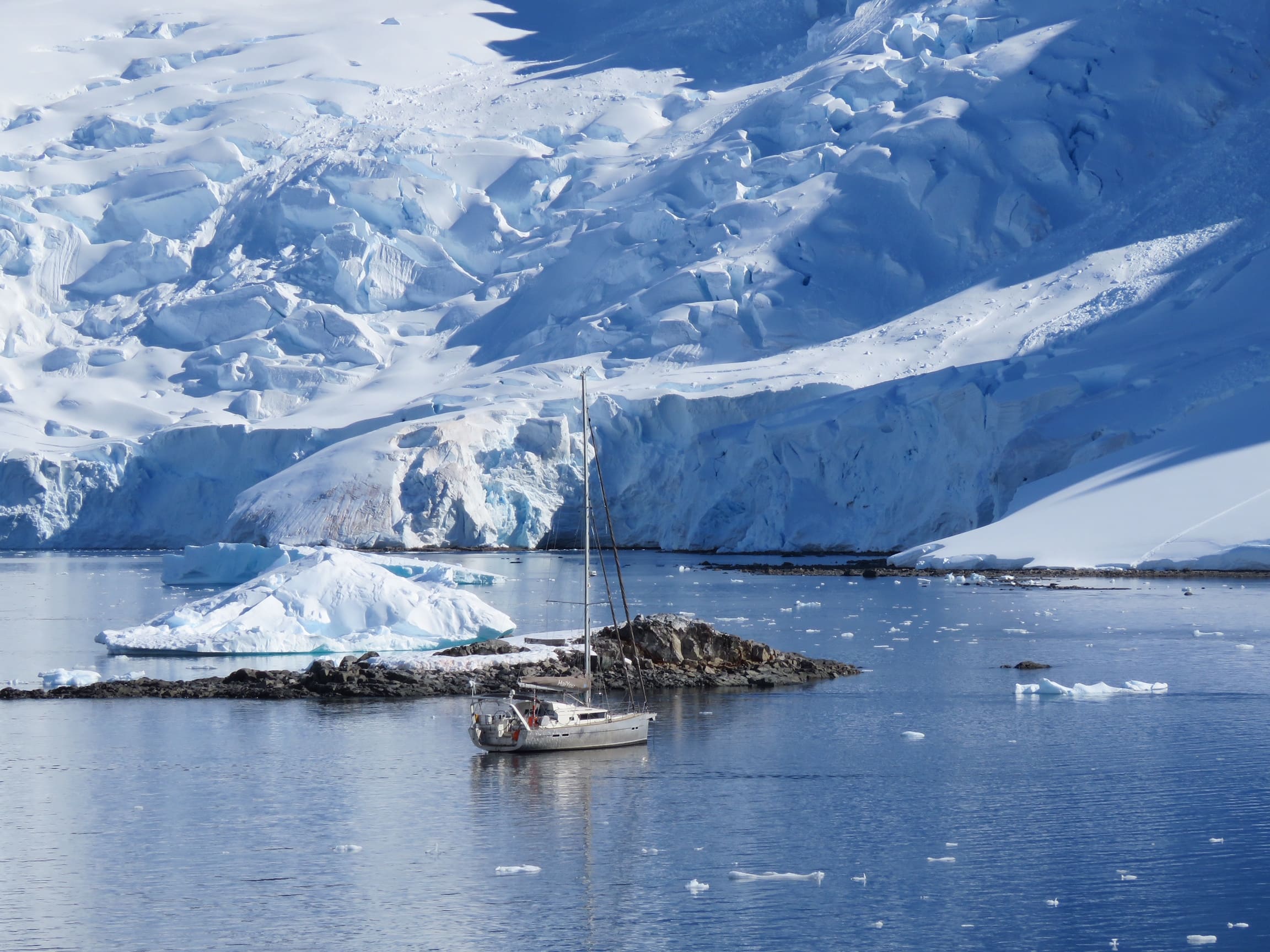
- Haiyou, an Exploration 45, explored Antarctica
- Marisa & Adriano also crossed the Northwest passage on their Exploration 45
- BalthazaR, Jimmy Cornell's original boat, returned to Antarctica with a new owner
- Polaris, an Exploration 52, offers Arctic cruises in Svalbard
Read their stories and feedback on our blog
➡️ Garcia sailor stories

Conclusion: the expedition yacht, your partner for true adventure
A true expedition sailing yacht is more than a strong boat—it’s a dependable, protective home that lets you embrace adventure without compromising on safety or comfort. If you dream of high-latitude expeditions or sailing to the ends of the earth, this is your vessel.
Why choose an aluminium bluewater sailboat for your long-distance cruising project?
A Blue water cruiser isn’t just a sailboat, it’s a mobile home, a refuge, and a long-term companion designed to endure and deliver comfort anywhere on the planet. At Garcia, we’ve made a clear choice: aluminum is the best material to support ambitious bluewater sailing adventures.
Strenght to match the challenges of offshore cruising
When circumnavigating or crossing oceans, you’ll face changing—and sometimes harsh—weather. You might need to anchor in remote or poorly charted areas. And although rare, collisions with floating objects do happen.
Aluminium provides exceptional impact resistance to bluewater sailboats. It might bend, but it doesn’t break—and it’s easily repaired, even far from any marina. In other words, aluminium is the best material to go far, for a long time, with confidence.

Safety and lightness: Key allies for ocean going performance
An offshore cruising sailboat must be both strong and responsive: speed, handling, and stability are crucial to safety. Being able to outrun a squall or reach shelter faster can make a difference.
Aluminum is lighter than steel and stronger than fiberglass, making it ideal for building high-performance ocean-going sailboats. This weight advantage allows for increased payload, greater responsiveness, and better sailing behavior.
Longevity, reliability and peace of mind
A bluewater sailboat is constantly exposed to wear and tear—whether at sea or at anchor. Materials fatigue, and corrosion is a long-term concern.
Properly protected by sacrificial anodes, an aluminium hull ages very well. It offers lasting value, reduced maintenance, and a strong resale price—making it a reliable long-term investment.
Garcia Yachts aluminium sailboats: Designed for long-distance cruising
A Garcia yacht is more than just an aluminium hull. We’ve specialized in aluminium bluewater sailing yachts for decades. The Exploration range—45, 52, and 60 feet—was designed in collaboration with explorer Jimmy Cornell, specifically for long voyages, including high-latitude sailing.
➡️ Discover our range of aluminium hull sailboats
➡️ Tour the Garcia Exploration 45 with Marisa & Adriano (EN)
All the benefits of aluminium, without the downsides
Many aluminum sailboats are known for being spartan. Not so with Garcia. Our aluminum bluewater sailboats feature high-end finishes, luxurious interiors, and top-notch thermal and acoustic insulation.
We also eliminate corrosion concerns. Garcia integrates advanced practices against galvanic and electrolytic corrosion, ensuring peace of mind through good design, electrical engineering, and routine anode checks.
Bluewater cruising yachts built by and for real sailors
The Garcia Exploration 45, the first of its kind 45-foot sailboat for bluewater sailing , was developed with Jimmy Cornell. While preparing for the Northwest Passage, he had specific requirements in mind:
- Aluminium hull for safety and strength
- Integral centerboard for shallow anchoring and stability at sea
- Dual watch zones: protected outside cockpit and inside nav station
- Thermal insulation and double glazing for extreme temperatures
- Accessible technical spaces, generous storage volumes, redundant systems
[.content-en] ➡️ Discover our range of aluminium sailboats for blue water cruising [.content-en]
[.content-en] ➡️ Explore Marisa & Adriano's experience aboard their Garcia Exploration 45 [.content-en]
[.content-en] 👉 Dreaming of a great voyage aboard an exceptional sailboat? Write to us at sales@garciayachts.com: we'll be delighted to discuss the Garcia sailboat best suited to your project. [.content-en]
Blue water cruising & aluminium vs other hull materials
Which is the best material for long-distance sailing? Here's a comparison of common hull types for bluewater cruising sailboats:
➡️ What are the advantages and disadvantages of an aluminium bluewater sailboats?
Aluminium sailboats are strong, repairable, lihgtweight, long-lasting and ecofriendly as they are built of a recyclable material, but frequently have a higher upfront cost when compared to sailboats built with other materials (steel, fiberglass).
➡️ What are the advantages and disadvantages of steel sailboats?
Steel sailboats are very strong and affordable, but these advantages come at the expense of a higher weight, less corrosion resistance (compared with aluminium), and a less agile hull.
➡️ What are the advantages and disadvantages of fiberglas (GRP) sailboats?
Shipyards building fiberglass sailboats benefit from flexibility when designing and building boats with attractive curves. On the other hand, fiberglass sailboats are fragile to impact and difficult to repair offshore.
For those seeking to sail far and wide -without compromise- aluminium remains the ultimate blue water ally.
The essential qualities of a sailboat designed for polar expeditions or high-latitude exploration
High latitudes refer to areas beyond 60° north and south latitude. In the Northern Hemisphere, in the Arctic, we think of Iceland and Greenland, with their breathtaking landscapes. And the mythical Northwest Passage, which links the Pacific and Atlantic oceans via the north of the American continent. In the southern hemisphere, although a little above the 60th parallel, Patagonia, the Falklands, South Georgia, the Kerguelens, Crozet... are also dream destinations, where some dare to venture. And last but not least, Antarctica, thanks to the possibility of receiving reliable weather forecasts for several days ahead, is also becoming a playground for sailors who love wide open spaces.
But sailing in these conditions, with their sometimes freezing temperatures, often very strong winds and the presence of drifting ice and icebergs, requires a sailboat designed to cope with these conditions. Let's take a look at the essential features of a sailboat designed for high latitudes.
Ice-strength
Even if you venture into these waters during the summer, you're bound to encounter icebergs that you can avoid, but also growlers that will rub against your hull. A sailboat destined for polar sailing must have a reinforced hull capable of withstanding impacts with ice.aluminium, the material used by Garcia Yachtsis ideal for this: it's light, strong and can deform without breaking on impact.

Thermal insulation for extreme temperatures
In high latitudes, temperatures can drop well below freezing. Maintaining a comfortable temperature inside the boat without consuming too much energy is essential. Garcia Yachts sailboats are designed with double-glazed windows and full thermal insulation, which reduce condensation and help maintain a comfortable temperature on board, even in the depths of the Arctic winter.

Autonomy: essential far from any port
When you venture into high latitudes, you know you're going to find very few ports on your itinerary. It's therefore impossible to refill diesel tanks, stock up on victuals or find spare parts. A sailboat designed for high latitudes must therefore be able to sail autonomously for several weeks at a time, with ample carrying and storage capacity, large fuel tanks, and high-performance energy production and communication systems.

centerboarder : an asset on the rough seas
Venturing into high latitudes means accepting the possibility of encountering very rough seas with breakers. A centerboarder, with the daggerboard raised when sailing downwind, will behave more smoothly and safely in the event of breakers, over which it will glide, without the tripping effect of a keelboat. This is an essential characteristic of Garcia Yachts (find out more about the centerboarder).
High latitudes, polar challenges, the Northwest Passage: why choose a Garcia sailboat?
Did you know? At the origin of the creation of the Garcia Exploration 45, released in 2013, was Jimmy Cornell's project to complete the Northwest Passage. He approached the Garcia YachtsGarcia Yachts, in whom he had the utmost confidence, to design and build a boat made to tackle these high latitudes.
The main elements of the specifications for tackling these magnificent, but not always welcoming, lands were: aluminium hull , for safety in the event of ice encounters; centerboarder, for seaworthy behavior in heavy seas at downwind speeds; deck saloon, for keeping watch from inside; interior thermal insulation, double glazing and watertight door, to maintain a mild temperature inside. An ideal sailboat for high latitudes!
Real-world expeditions
After Jimmy Cornell, other sailors have visited these polar regions aboard Garcia. Discover the story of Life Explorer, a Garcia Exploration 52 that visited Svalbard (read the story). Or that of three Garcia Exploration 45 who successfully completed the Northwest Passage in 2024(read more). Or that of BalthazaR, another Garcia Exploration 45 , which made it to Antarctica in 2024(read the story).
Explore high latitudes with Garcia
The Garcia Exploration 45, 52 and 60 models have been specifically designed to navigate in these high latitudes. Safety, comfort, autonomy: everything has been thought out for adventuring in these polar regions.
Which sailboat should you choose for a solo, double or family round-the-world trip?
The choice of a sailboat for a round-the-world trip often depends first and foremost on the number of people who will be on board. Whether it's maneuverability for a small crew, volume, space, comfort or privacy for a family or several couples, it's crucial to choose the length and configuration of your round-the-world sailboat according to the number of people who will be on board. Each crew configuration has its own requirements in terms of size, space and comfort.
A sailboat for a solo round-the-world trip
Sailing alone means first and foremost choosing a sailboat that's easy to handle, both at sea and in port. A 40 to 45-foot boat is recommended. The Garcia Exploration 45 offers reasonable sail area, and the cutter sail plan with furlers makes maneuvering even easier. centerboarder, the boat is smoother downwind, with the daggerboards raised, and thanks to its twin rudders, puts less strain on the autopilot, essential for a solo sailor. We also appreciate the ease of movement and the number of handrails for safety.
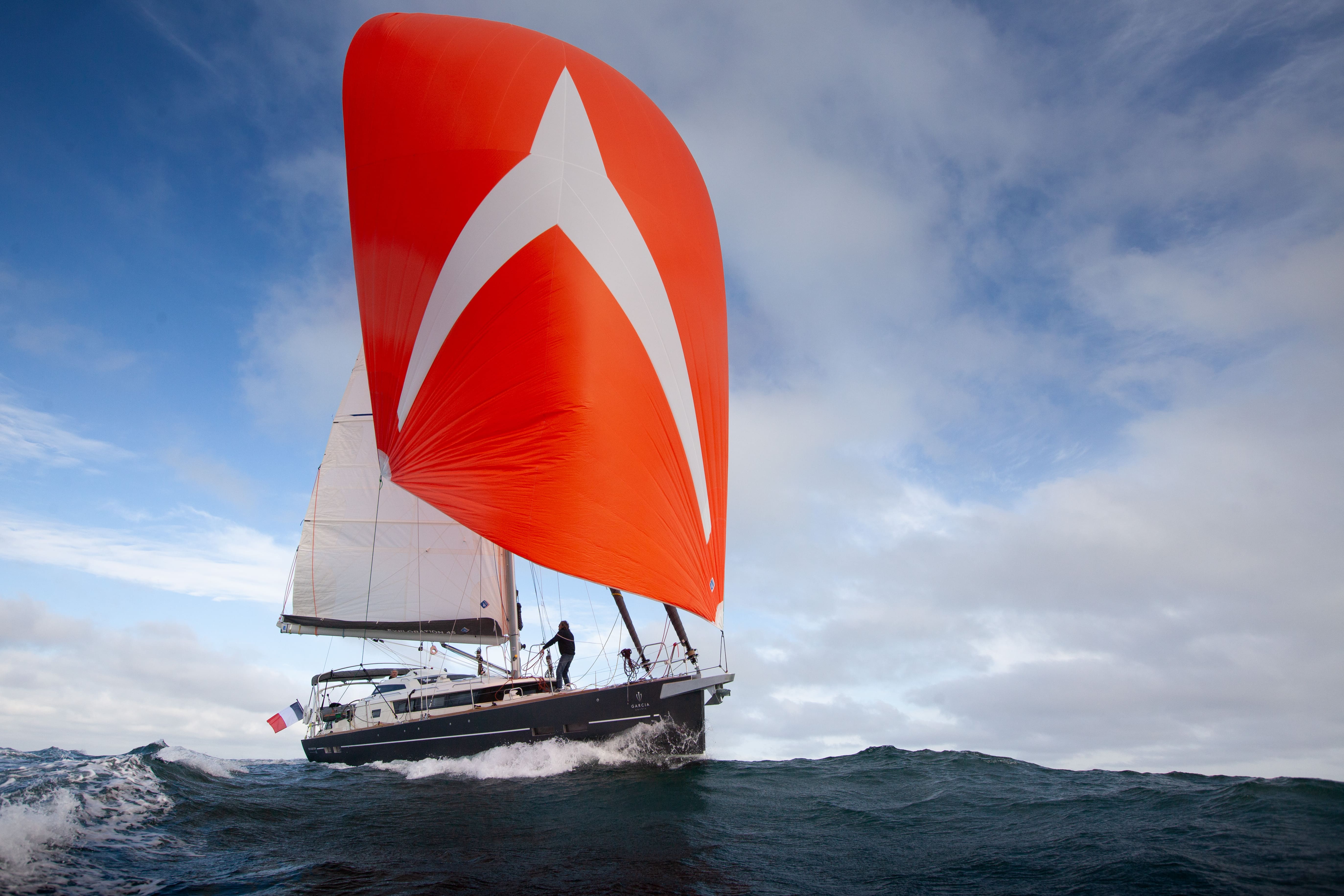
A sailboat for a round-the-world trip for two
For two people, you might consider a slightly larger yacht, between 40 and 50 feet, offering greater comfort without compromising ease of manoeuvring. The size will depend on the number of people you plan to invite to your stopovers. A Garcia Exploration 52, for example, offers different port aft cabin configurations, with single, removable double or permanent double berths. You'll also gain space in the saloon and cockpit to better accommodate family and friends.

Sailboat for a round-the-world family trip
If you're planning a family round-the-world trip, you'll want at least 3 cabins, so that everyone has their own comfort and a little privacy. In that case, you'll opt for a 50 to 60-foot yacht, or even a catamaran. You need more sleeping space, but also more stowage space, for your personal belongings, but also for supplies for several weeks at a time. Choose a Garcia Exploration 52, available in 2 or 3 cabins, or theExploration 60 in 3 or 4 cabins. If you're setting sail with young children, you'll particularly appreciate the deck saloon, which offers short descents with few steps. Another advantage of this configuration is that, when sailing, the saloon can be transformed into a double berth, making it an ideal living space for children, well secured and at the heart of the living area, but without disrupting the flow of traffic. The Garcia's well-protected cockpits, with their closed sterns, will also reassure parents.
A sailboat for a round-the-world trip with a crew
Some of you, for greater peace of mind, will decide to set off with the help of a skipper or a dedicated crew member. In this case, we'll be looking at boats offering interior configurations with a dedicated cabin, often a little removed from the central life of the boat, and with its own privacy. The Garcia Exploration 60 , for example, offers a cabin under the saloon, ideally positioned in the center of the boat. And a Garcia Explocat 52, in a 4-cabin configuration, can also accommodate a crew.

Round-the-world sailing: what characteristics should you take into account when choosing your boat?
monohull or multihull?
Is it a rational choice? There are enthusiasts on both sides. Objectively speaking, a monohull is simpler to handle, easier to slip in and out of... A catamaran undeniably offers more volume, and above all surface area: living area, cockpit surface area. But the sensations at sea are different. The choice really depends on your approach and sensations.
Keelboat or centerboarder ?
When sailing around the world, people often dream of the beaches of the Grenadines, the lagoons of the Bahamas, or the Pacific. The centerboarder offers an undeniable advantage: the ability to get as close to the shore as possible, while keelboats must stay further out, amidst the crowd of other sailboats. The centerboarder also centerboarder unmatched comfort at sea, particularly with the centerboard up during downwind legs—the most common conditions during a round-the-world voyage through the tropics.

Composite or aluminium ?
Here, too, there are the convincing arguments for each material. While there are many composite sailboats sailing around the globe,aluminium's unrivalled strength makes it an obvious choice for a round-the-world program. In the event of impact, it bends but does not break. And above and beyond the safety it provides, it is above all a real psychological comfort, bringing serenity to the crew.

A sailboat for extreme latitudes?
If you're planning to visit Svalbard, Tierra del Fuego, Antarctica or make the Northwest Passage, you need a sailboat designed for the job.aluminium is a must when it comes to tackling ice. Thermal insulation, combined with double glazing and radiator heating, as on a Garcia Exploration, will bring you another dimension of comfort. The deck saloon allows you to watch from inside when conditions are too cold or too rough.
Meeting the technical challenge of a round-the-world trip: the obvious advantages of an aluminium centerboarder
To sail around the world, you need a boat you can fully trust. A seaworthy boat that can handle all wind and sea conditions. Comfort on board is also essential for long periods of life at sea. The Garcia Yachts are ideal sailboats for a round-the-world voyage. Sturdy, with their aluminium hull , they are very safe. As centerboarders, they are very comfortable at sea and can access shallow anchorages. Their insulated interior, with double-glazed windows, is ideal for extreme temperatures. And their layout, featuring a deck saloon with a 270° view, allows for watchkeeping from inside, regardless of weather conditions.
Equipment & services: from must-haves to nice-to-haves
The essentials for sailing around the world
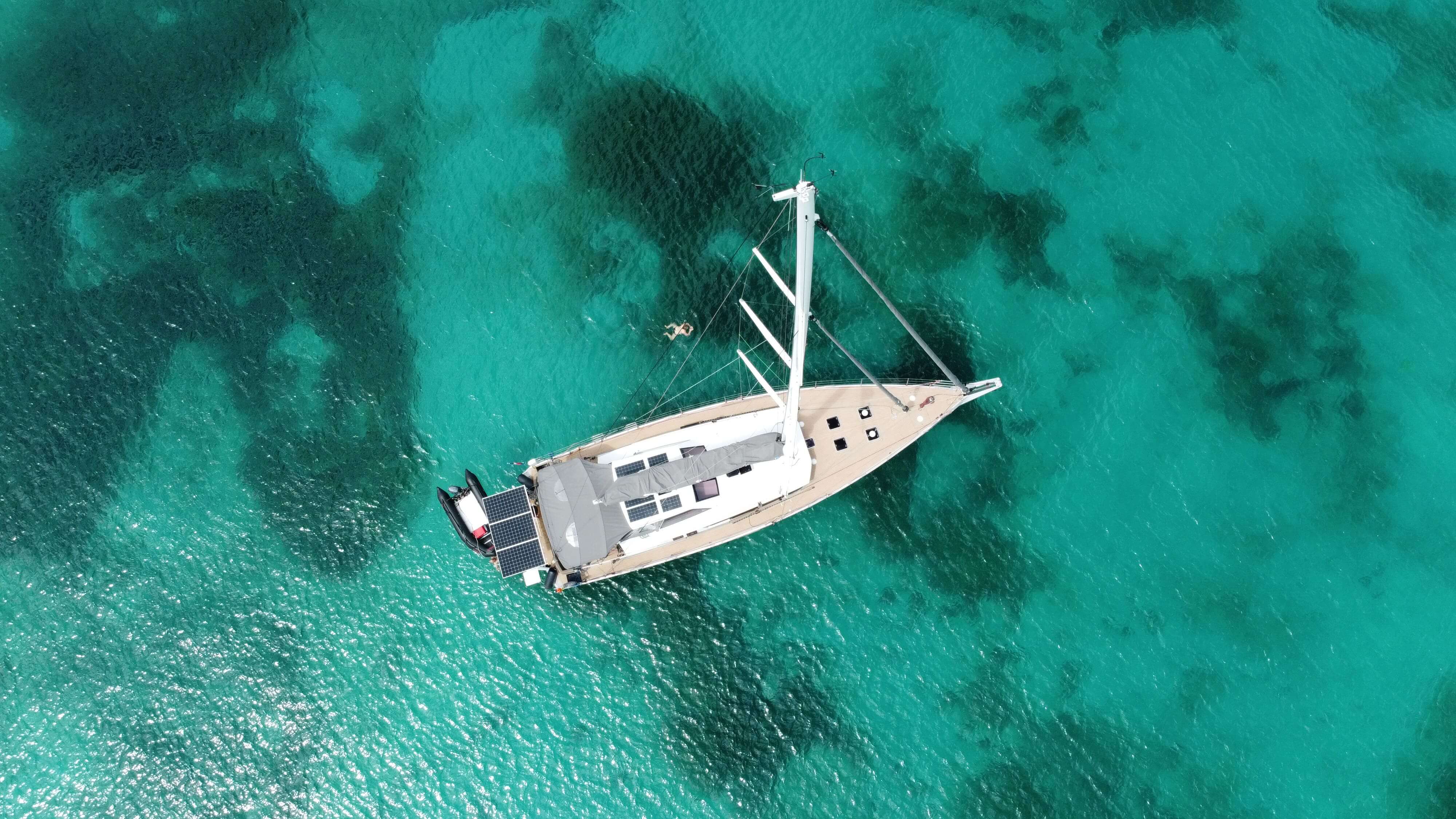
For a round-the-world trip, even with a crew, autopilot is highly recommended. As Garcia Exploration boats are double rudders, the boat is better controlled and the pilot is less stressed. Even if the Garcia Exploration boats have large water tanks, a Watermaker means that water use is less constrained, and you can be sure of the quality of your water, which is not always guaranteed in certain regions. In terms of electrical autonomy, Solar panels are the ideal solution for recharging batteries.
The "nice to haves" you won't want to do without
If you're planning to visit cold countries, heating is obviously essential. At Garcia Yachts you can also choose water radiator heating, which provides gentle, even heat. Depending on the type of equipment you want on board, in addition to the Solar panels, you can choose to install an electric generator for even greater autonomy. Then there's the question of Internet connection... Are you planning to cut yourself off from the world, or do you want to be able to check the weather at all times? The choice is yours...
Make your round-the-world sailing project a reality
Real-world expeditions
Many sailors have made their dreams come true with a Garcia sailboat. Read their testimonials on our blog:
Your world tour with Garcia
The Garcia Exploration 45, 52 and 60 models are designed to meet the demands of blue water cruising. Discover our sailboats and make your project a reality today!
In this article, we'll detail what makes the centerboarder such a special choice, its sailing benefits, its relative drawbacks and why it's ideal for sailors looking for freedom and security.
What is a centerboarder ?
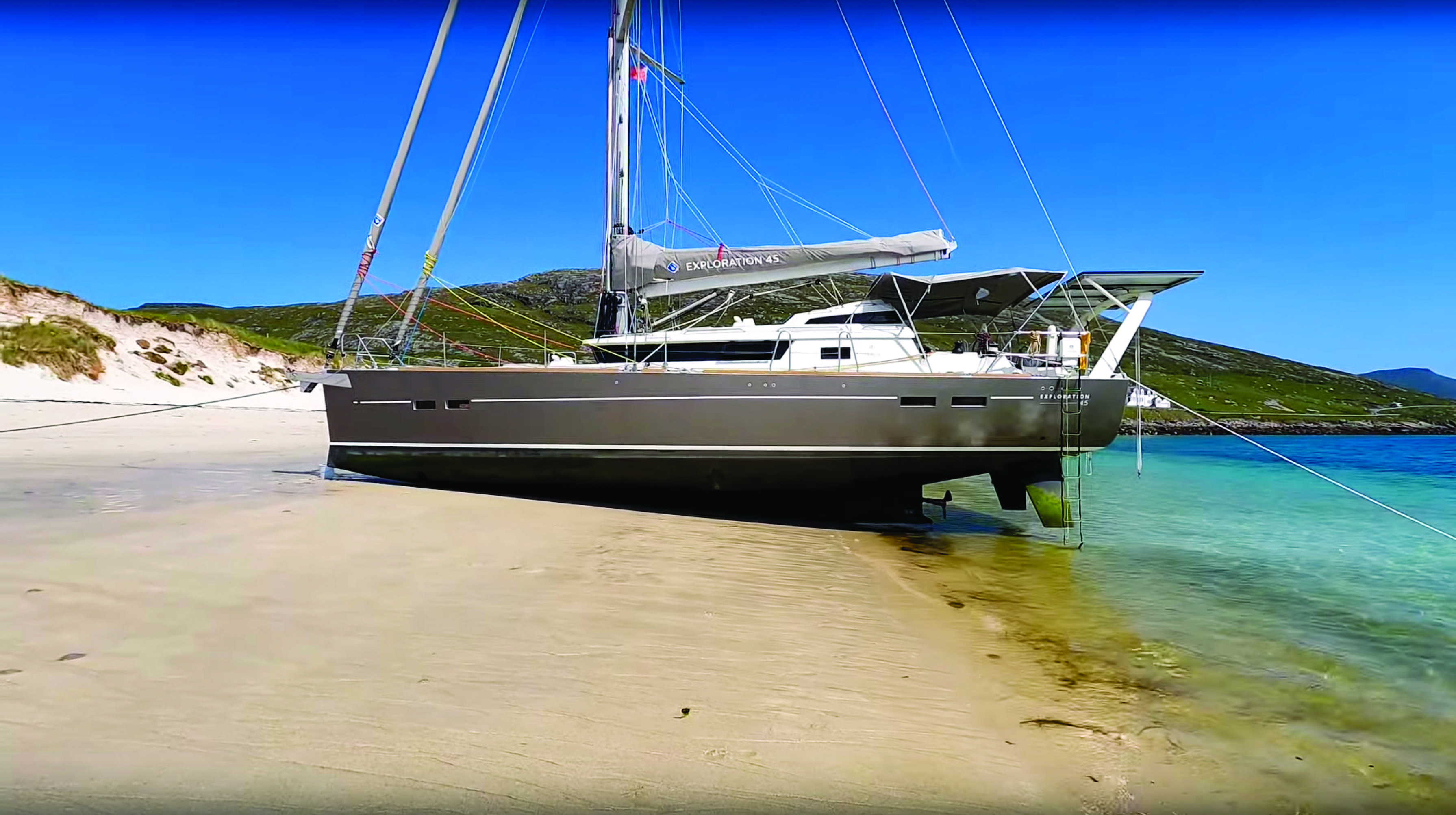
A centerboarder is a sailboat whose fixed keel is replaced by a mobile, retractable centerboard, which can be fully retracted into the hull by pivoting on an axis. This means that, in the raised position, the yacht can navigate in very shallow areas, and even run aground without risk on a beach or sandbank. When lowered, the centerboard acts as an anti-drift plane, as with a keelboat, enabling the yacht to sail upwind, hull, without skidding. centerboarders Garcia Yachts meet the same stability requirements as keelboats.
Compared with keelboats, centerboarder offer far greater sailing freedom. In particular, it allows access to wild anchorages in shallow waters, to get as close as possible to a beach where others can't go, and in bad weather, a centerboarder can also take shelter in small anchorages, sheltered from the coast. aluminium models, such as those designed and produced by Garcia Yachtscombine sturdiness and safety, essential for offshore sailing.
Advantages and disadvantages of aluminium centerboarder
Versatile navigation
The main advantage of a centerboarder, with its shallow draft, is the ability to access shallow waters. Unlike keelboats, a centerboarder can reach beaches, lagoons, and rivers with ease. With a safe aluminium hull , even the most adventurous explorers can venture with confidence into areas that are still poorly charted. For long-distance travelers, the centerboarder therefore the ideal solution.
Smooth sailing
With the centreboard raised on downwind points of sail, a centerboarder offers a much smoother ride, thanks to the virtual absence of roll. In heavy seas, the boat can skid sideways, with no side-hook effect, and - the ultimate safety feature - remain maneuverable, even in breaking waves. Life on board is all the smoother and more comfortable, which is essential for long crossings lasting several days or even weeks.
Security
From a safety point of view, a centerboarder, thanks to its Shallow draft , can find shelter as close to the coast as possible, in a shallow cove, in the event of very bad conditions. A keelboat will be unable to do the same.
Upwind performance
In the minds of many, centerboarders offer poor upwind performance. But today's hulls have undergone a major evolution and have gained in performance. Of course, a centerboarder will never head as far upwind as a keelboat, but the great French naval architect Olivier Racoupeau has designed modern, stable and well-balanced hulls for the GarciaExploration that sail upwind honestly, thanks in particular to their optimized weight distribution, inertia and comfortable passage through the wave.
Care and maintenance
A centerboarder allows you to land on a beach. When blue water cruising, you can inspect your living works without having to take the boat out of the water. It also provides easy access to sacrificial anodes for checking and replacement. If the boat needs to be taken out of the water for wintering, it will always be easier to handle and find a place for a centerboarder.
Analuminium centerboarder to go where?
Offshore sailing and blue water cruising
A centerboarder is ideal for ocean-going adventurers, from the Northwest Passage to the Tropics. Its comfort at sea, especially downwind, is particularly well suited to this program.
Blog link to "Grand voyage" article
Coastal navigation and shallow waters
For those who don't plan to cross the ocean, the centerboarder is just as suitable, thanks to its Shallow draft , which allows access to the most isolated anchorages, close to shore or in rivers.

Difficult weather conditions
For sailors who are going to encounter strong wind and sea conditions, particularly in the Arctic and Antarctic, the centerboarder is also especially recommended, both for its seaworthy qualities in heavy seas, and for its ability to take shelter in inaccessible areas.
Blog link to "Hautes Latitudes" article
Around the world
Whensailing around the world, mostly on downwind points of sail, when weather hazards may be encountered, when the boat will need to be checked and sometimes wintered ashore, the aluminium centerboarder is undeniably the ideal solution.
Blog link to "Around the world" article
The centerboarder by Garcia Yachts
Garcia Yachts designsaluminium centerboarders Twin rudders, built for adventure. Given all the qualities listed above, the shipyard is convinced that these are the best type of sailboats for exploring the world under sail, off the beaten path. The Garcia Exploration liveaboard sailboats, available in 45-, 52-, and 60-foot models, also offer exceptional onboard comfort, thanks in particular to their deck saloon, thermal insulation, and unparalleled build quality.
Thealuminium centerboarder represents the quintessence of the cruising sailboat: freedom, safety and versatility. At Garcia Yachtswe are passionate about developing them for sailors in search of distant horizons. Whether it's an expedition in cold seas or an exploration of turquoise waters, our sailboats are designed to take their owners wherever their dreams take them.


